
Manchester Previous Residents by Record Era
Previous residents are found by moving from the newest address key toward older evidence. Ocean County’s current tax records identify the parcel and may show a deed date, book and page, prior parcel identifiers, sale history, and separate mailing and location fields. SearchNG provides the recorded-instrument layer online from April 1, 1977. Earlier research uses the County Clerk, State Archives, historical collections, and library sources. Directories and census schedules add household context, but neither replaces the legal parcel or recorded deed trail.
| Source | Years it covers | Where held | What it shows |
|---|---|---|---|
| Ocean SearchNG deeds | 1977 to present online | Ocean County Clerk | Recorded parties, instrument, date, book/page, and legal references |
| Earlier deeds | Exact county bridge not verified; State Archives deed microfilm through 1900 | Clerk, State Archives, and historical research routes | Earlier transfers and legal descriptions |
| Tax and assessment record | Current portal; reports 2000–2026 | Ocean County Board of Taxation | Parcel, class, assessment, sale, and mailing/situs clues |
| Manchester permits | Online archive start not stated | FastTrackGov portal and township records | Application date, type, status, address, and property activity |
| Directories and census | Exact Manchester directory years unverified; census generally public through 1950 | OCL, Wheeler Room, licensed tools, and archives | Published or enumerated household snapshots |
| Newspapers and maps | APP historical archive 1905–2011; Beers map 1872 | OCL resources and Library of Congress | Announcements, obituaries, owner, building, lot, and place context |
For a recent transfer, begin with the tax parcel and deed reference. For a nineteenth-century question, work from the legal description toward deed microfilm, the 1872 map, and archive sources. A missing city-directory volume is a reason to change record types, not to assume an address was unoccupied.
Manchester Parcel Records Start the Past-Resident Trail
The Ocean County tax search accepts municipality, block, lot, qualifier, property class, and property location. Select Manchester or Mnchstr, then record the location address, block, lot, qualifier, map, tax year, deed date, and book/page shown on the parcel detail. The public landing page does not offer owner name as a dedicated first-screen field, so an address or parcel key is often the sensible starting point. A parcel detail can also display prior sale or parcel information that helps locate the preceding instrument.
Insider tip. Keep the mailing address and property location in separate notes. The tax card treats them as different fields. A mailing address can be a useful lead, but it can belong to an office, estate, or other representative rather than a person who lived at the property.
The Ocean County Clerk records page is the source linked before this view of the county records office.
The Clerk’s office supplies the recorded-document route after the tax card provides a parcel and deed reference.
GIS is the second parcel check. The Ocean County GIS links parcel geometry, tax maps, municipal boundaries, zoning, flood, and related layers. Use it to confirm the map sheet and block/lot, not to decide who occupied a home. Parcel polygons are not surveys or legal boundaries, and a map shape does not establish a household relationship.
Trace Manchester Previous Residents Through Deeds
Deeds identify recorded parties, not a guaranteed list of everyone living at an address. Still, a chain of title is the most reliable backbone for a past-resident investigation because the legal description can stay stable when a street number or postal label changes. SearchNG supports party names, dates, town, block and lot, legal-description lines, map and parcel modes, and linked documents. Its party-name guidance uses Last-Name First-Name without commas, begins-with matching, and More Names for spelling variants.
- Open the current tax parcel and record the deed date, book/page or instrument reference, municipality, block, lot, map, and legal description.
- Use the current owner as a grantee lead in SearchNG, then inspect the recorded deed and any linked documents.
- Record the named seller as the grantor and search that party as a grantee in an earlier period to find the prior acquisition.
- Repeat the sequence while comparing document type, town, block/lot, legal-description line, and reference number at each transition.
- When the search reaches the online cutoff, contact the Clerk or use archive and microfilm routes rather than inventing a missing link.
- Grantor and grantee
- The grantor is the party transferring an interest; the grantee is the party receiving it in the recorded instrument.
- Chain of title
- A dated sequence of recorded transfers connected by the same parcel or legal description.
- Legal description
- The parcel wording, map, block, lot, or similar identifier used in records. It can be a safer continuity key than an old street number.
Assignments, releases, corrections, and trusts can interrupt a simple sale-to-sale story. SearchNG flags replacements and corrections, and its linked documents can lead to prior or related records. Record the party role exactly as the index displays it before deciding that a document shows a transfer of ownership.
Manchester Previous Residents and the 1977 Cutoff
The Ocean County Clerk’s online official-record index begins April 1, 1977. That divide is the key access fact for a Manchester backward trail. A search can find post-cutoff indexing online, while older records require a different route. The Clerk counter or request process, State Archives county deed microfilm through 1900, FamilySearch’s New Jersey wills and deeds collection, and Ocean County Historical Society research are documented leads. The exact Ocean County pre-1977 deed-book bridge and local microfilm availability were not established in the research, so confirm the series with the custodian.
The SearchNG official-records page is the source linked before this grantor-grantee search view.
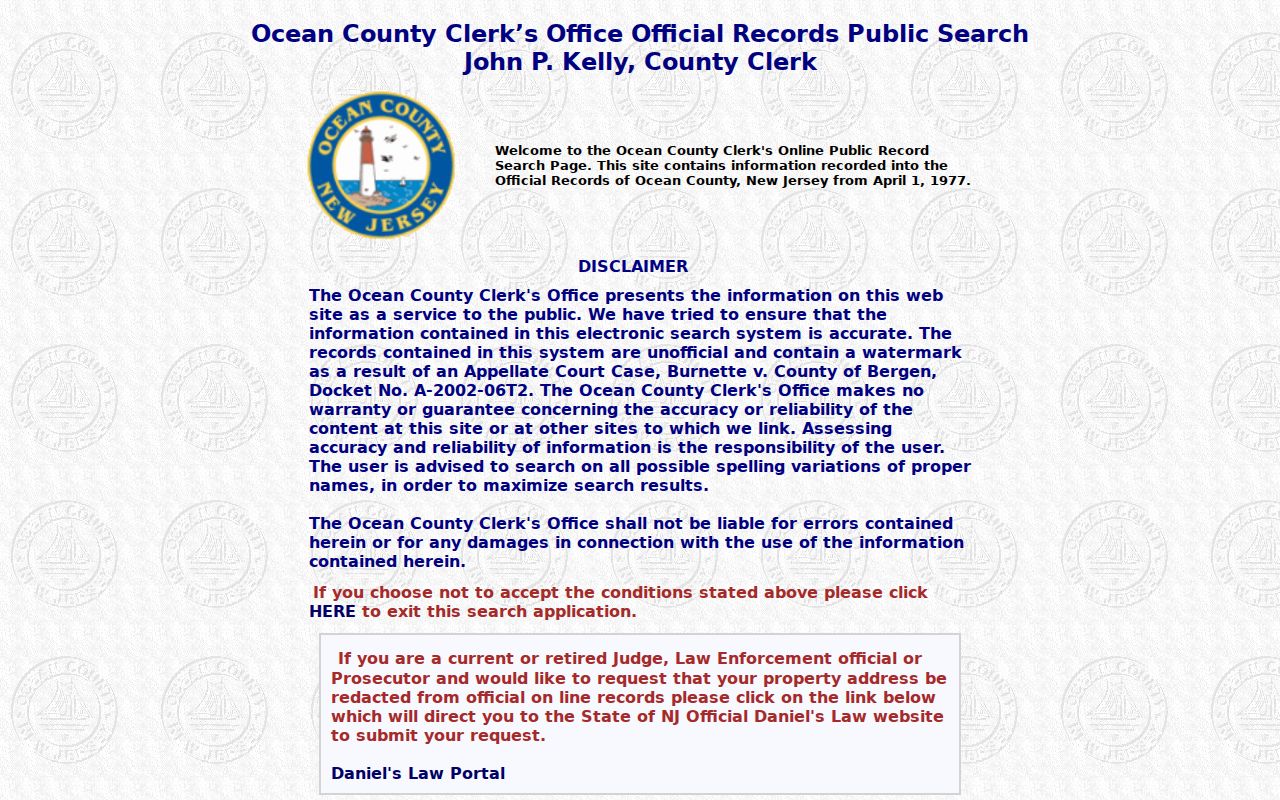
SearchNG makes the online part of a deed chain searchable, but its image, print, cart, and account access can differ from the free index.
The access paths are not interchangeable. A public index can identify a document, an image view may have separate access behavior, an OPRA request asks for an existing record, and an archival or Historical Society request may be needed for older material. The Historical Society lists a $15 nonmember full search, a $5 member full search, and a $5 search for a specified obituary, funeral, or Bible item. Ask for a defined record, name, property, or date range.
Manchester Record Keys Outlast Old Addresses
Myth: the modern street number is always the best way to find who lived here before. No official Manchester street-renumbering or renaming history was located, so no year should be assumed. A failed address search should trigger a comparison of the official street index, historic map, tax map, deed legal description, and block/lot rather than a conclusion that the older record does not exist.
Manchester’s history adds place-name changes that matter in older sources. Whiting is named in the official history in 1861, Manchester Township was created in 1865, and Lakehurst separated in 1921. A map, deed, newspaper, or directory may therefore use Whiting, Lakehurst, Manchester, or Ocean County as its local heading. The 1872 Ocean County Beers map gives landowner, building, lot, and town-inset context, but it is not an address list and should not be used to make a present-day occupancy claim.
Keep the modern situs address, postal city, parcel key, and legal description as separate columns in a house-history log. That simple separation prevents a tax mailing address or later postal label from being projected onto an older deed or directory entry.
Note: When an address fails, legal description and block/lot are stronger continuity checks than an unchanged street number.
Manchester Past-Address Permit Records
Manchester’s FastTrackGov permit portal can bracket physical changes at an address. The township procedure directs a searcher to choose Any Date for application date and All for status, then enter a street number and street name. The portal also accepts permit type, application date range, permit or application ID, violation ID, contractor or agent, city, block, postal code, lot, qualifier, and status. An Application ID opens detail with the available permit type and status information.
A permit dates an application or administrative activity, not a household. It can help explain an addition, demolition, zoning change, or construction period while the tax parcel and deed chain establish the property record. The online archive’s start year and retention schedule were not located, so a no-result is not proof that older work never occurred. For a gap, contact the township records route and request a defined existing permit or inspection record.
The vacant-property registry is another limited municipal clue. It began under a 2016 ordinance amendment and concerns municipal status, not proof of who lived at the address. Treat permit, code, and registry information as dated administrative evidence, then compare it with the parcel and document chain.
Manchester Previous Residents in Directories and Census
Ownership is only part of who lived here before. The Ocean County Library’s Wheeler Room holds old city directories and phonebooks, yearbooks, maps, atlases, and historical printed material. The library’s genealogy resources include HeritageQuest and the Asbury Park Press historical archive, which covers 1905–2011 with a known 1999–2005 obituary gap. The public catalog documents 33 city-directory subject records and 12 microform records, but it does not expose an exact Manchester or Whiting run. Confirm a particular volume before using it by address.
- Locate a confirmed directory or phonebook volume for the needed place and publication year, then copy the printed name and address exactly.
- Check the next and prior available volume for a move, spelling change, or confirmed address-ordered section.
- Pair the directory publication date with the nearest federal census enumeration date, preserving both dates in the log.
- Use a newspaper announcement or obituary to test a move or death lead, then use probate for an estate filing where appropriate.
The collections themselves are described in the Manchester City Directories resource. A directory may include a household or address at publication time, while a census captures people counted on its own date. Neither source turns a historical listing into proof of a current resident.
Manchester Records Endpoints for Past Residents
Newspapers, probate, maps, and archives can close parts of a house-history trail. OCL’s historical Asbury Park Press collection provides full text and page images for 1905–2011, though the current database notes missing obituaries for 1999–2005. The Ocean County Surrogate’s Bluestone index can provide estate leads by name, first name, docket, case type, date, and town; secure images may not be available. A probate filing can identify an estate event or representative, but it should not be treated as a full household record.
The Ocean County Historical Society Research Center has family-name materials, local archives, on-site reference access, and paid remote research. The State Archives genealogy guide, FamilySearch collection, and the Library of Congress map are complementary routes for older work. A local Manchester house-history guide or a confirmed Manchester Sanborn edition was not located, so request a particular collection or map edition before assuming that it exists.